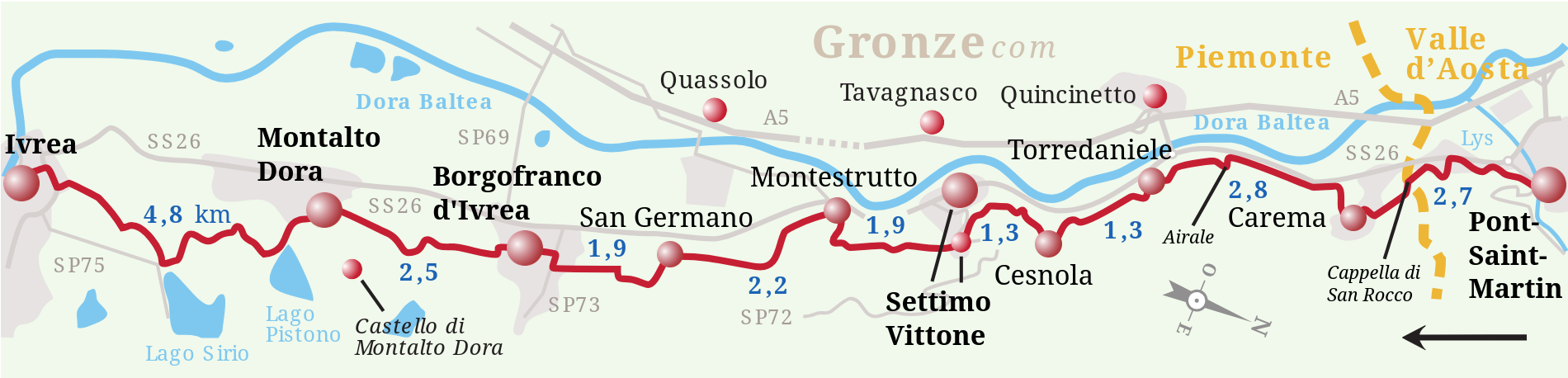
This could be a melancholy day as you say goodbye to the beautiful mountains of the Aosta Valley
and enter the flatter region of Piemonte, except that a few castles and interesting villages
add more than a little delight. Footing can be treacherous on the way into Carema, and around Montestrutto.
Carema’s name derives from cameram for ‘customs’ due to its historic role as the border town between
the regions of Piemonte and Aosta. Wine terraces here are famous for production of the Carema wines.
The central fountain was built in 1571 and the Latin inscription in English means ‘If anyone is thirsty,
come to me and drink.’
The downhill is intense, with tricky footing, though at least in the most difficult
portion there is a rope handhold fastened to the cliffside. After Carema, the vineyard
route continues on the mountainside, while our route instead heads down to the valley
joining the $$26 highway for a hazardous roadside walk until just before Airale to enter the next village,
Torredaniele (0.9km, café). Walk between the Church of San Pietro and its tall tower within the tight,
medieval confines of the village. Local tradition says that the tower was built here in the 6th c.
to defend a Benedictine monastery. Set at the entrance to the Canavese plain, Settimo Vittone traces its
roots back to a Salassi settlement at this location. After conquest by the Romans-_
its name was changed to indicate it was seven Roman miles up the road to Aosta.
Local lore says that Ansgarde, Queen of Burgandy lived here in the 9th C.
Settled by Celts from around the 5th c. 8c, Ivrea first appears in documents as a
Roman outpost called Eporedia. Remains of a Roman amphitheater lie just east
of the city center. After the fall of Rome, it was variously under control of the
Lombards, Franks, and the House of Savoy. Sigeric stayed here, noting its name
as Everi, his Stage XLV. The 11th c. Cathedral of Ivrea was rebuilt in 1785 in
Baroque style above town, and the nearby tall, brick Castello Sabaudo of Ivrea
was built in 1357 by Amadeus VI of Savoy. The Romanesque Tower of St Stephen
in the SE center city was built in 1041 for a Benedictine abbey located at its base.
Ivrea was headquarters of the once-mighty Olivetti typewriter company, and
in 1970 the town swelled with 90,000 industrial workers. On the last three days
of Carnival each year, the Battle of the Oranges is waged. According to legend,
the festival arose when a miller's daughter refused to grant the local duke his
‘right’ to spend a night with her before her wedding. Instead she chopped off
his head. During the festival townspeople throw some 265,000 oranges at actors
representing local nobility.
Ivrea is a town founded by the romans around 100 b.Chr.
The historic city center spreads over both sides of the Dora Bàltea river.
Ivrea used to be a key pilgrim stage during the Middle Ages already operating
some 10 hospices for pilgrims at the time.
The well maintained «Castello delle Torri Rosse» (1358),
the cathdredal «Santa Maria Assunta» (construction started around 970)
and the bridge «Ponte Vecchio» built by the romans during the 5th century are key highlights worth to be explored.
Bus: www.savda.it.
Train: www.trenitalia.com.)
www.fortedibard.it).
Guide book Stage12 Pont-Saint-Martin to Ivrea